

Confidence tanks; Nvidia loses $US1.3tr in value; art auctions boom
News in brief
Housing downturn approaches 40-year record
Australia's property downturn is approaching the worst in four decades. Combined capital city home values have fallen 8.1 per cent, just shy of the 8.2 per cent record decline recorded between 2017 and 2019.
ASX hits 11-week high as oil prices tumble
Australian shares jumped 1.1 per cent to 9,129 points, their highest level in 11 weeks, after oil prices fell below $US92 a barrel. Investors welcomed Donald Trump's claim that the military phase of the Iran war was over.
Nvidia loses more than $US1 trillion in value
Nvidia has shed more than $US1 trillion in market value since its peak last month, amid concerns about AI investment and the scandal involving chief executive Jensen Huang. The company's board is investigating his relationship with a woman suspected of Chinese intelligence links.
Australia announces mandatory AI safety rules
The federal government will introduce mandatory safety standards for AI companies following a breach of a Medicare statistics website by an OpenAI agent. A new regulator will oversee requirements including incident reporting, independent testing and security controls, backed by significant penalties.
Qantas to outsource 850 head office jobs
Qantas will outsource 850 head office positions to consulting firm Accenture under a seven-year technology overhaul. The airline plans to replace more than 1,000 outdated applications and expand its use of artificial intelligence.
Global art market stages spectacular comeback
The world's biggest auction houses recorded $6.8 billion in sales during the first half of 2026, up 70 per cent on a year earlier. A Jackson Pollock fetched $181 million and a Mark Rothko sold for $98 million. Next week, Sotheby's will auction 12 paintings expected to raise more than $450 million.
Fear-o-meter
Jensen Huang’s email to Nvidia staffers:
I owe my family and all of you an apology.
I was unfaithful to my wife. My actions hurt her and our children. There is no excuse for what I did. I am deeply sorry.
Throughout my life, my family has given me love and support. They deserve my honesty and loyalty. Instead, I let them down and damaged the life we built together. I take full responsibility for what I did and the hurt I caused, and I accept the criticism that comes with it.
To my wife and family: I love you. I know an apology cannot undo what I have done. I hope our family will heal and that, over time, I can earn back your trust.
To my colleagues at NVIDIA, including those I have worked alongside for decades, and to our board, partners, and shareholders around the world: you deserve better from me.
Leading NVIDIA is the privilege of my life. My responsibility is to serve you and be worthy of your trust. I have fallen short of that responsibility. I am fully committed to NVIDIA and will work to earn back your confidence.
Regarding the national security concerns raised in news reports, NVIDIA's Board of Directors has initiated an independent investigation. I support the investigation and will cooperate fully. I love our country and our company, and I am committed to protecting NVIDIA and supporting America's national security. I am proud and grateful to be an American.
My family bears no responsibility for my choices. I do. Please give them privacy.
Fear & Greed Q+A today
On the convergence of traditional finance and crypto, and an insight into security within the sector after the $US6.3 billion Binance hack:
"Firstly, this was an incredibly significant event for the industry. I think particularly in recent days, Binance has very much bounced back and been very open on what happened in terms of sharing code, working with the FBI.
They've actually worked with Coinbase. We were unaffected by this, thankfully, and that's really very much due to constant vigilance as we think about the resilience of our networks.
This was a hot wallet incident... that's where funds are on a server, on an exchange, which you can access immediately. Coinbase uses two kinds of storage. Hot wallet storage is a very small percent of assets, so that they're readily available if customers want to withdraw them outside of Coinbase, but over 99 per cent of assets stay in our cold wallet storage.
That has multiple layers and protections and distributed key protection, rate limits, anomaly detection, kill switches, et cetera, that make it very hard to access at scale at the level of what we saw with the Binance hack.
We'd actually simulated these job application, social engineering scams before. And this has actually happened in Hong Kong in the last eighteen months, this exact same scenario.
So it wasn't new or novel, but it was just very much at scale. And so we'd like to think that this can't happen with our current setup at Coinbase. But it's constant vigilance, and we're doing a huge amount internally to stay on top of these things."
Consumer and business confidence plunges
Australian consumer confidence has fallen to levels rarely seen outside major economic crises, raising concerns about a sharp slowdown as higher interest rates and inflation squeeze household budgets.
The Westpac-Melbourne Institute Consumer Sentiment Index dropped to 78.2 in November, its weakest reading since late 2022, when inflation was approaching eight per cent.
Before that, similarly pessimistic readings were largely confined to recessions, the global financial crisis and the pandemic.
Mortgage holders are particularly worried, with confidence plunging 11.6 per cent to a record low.
Businesses are also becoming increasingly pessimistic.
NAB's latest business survey shows confidence fell to minus 15 in October, among the weakest five per cent of readings in its history.
More concerning, forward orders plunged to their lowest level since the height of the pandemic, suggesting businesses expect demand to deteriorate significantly.
Forwarded from a friend? Sign up to our daily newsletter
Listen to today's episode 🎧
Greed-o-meter
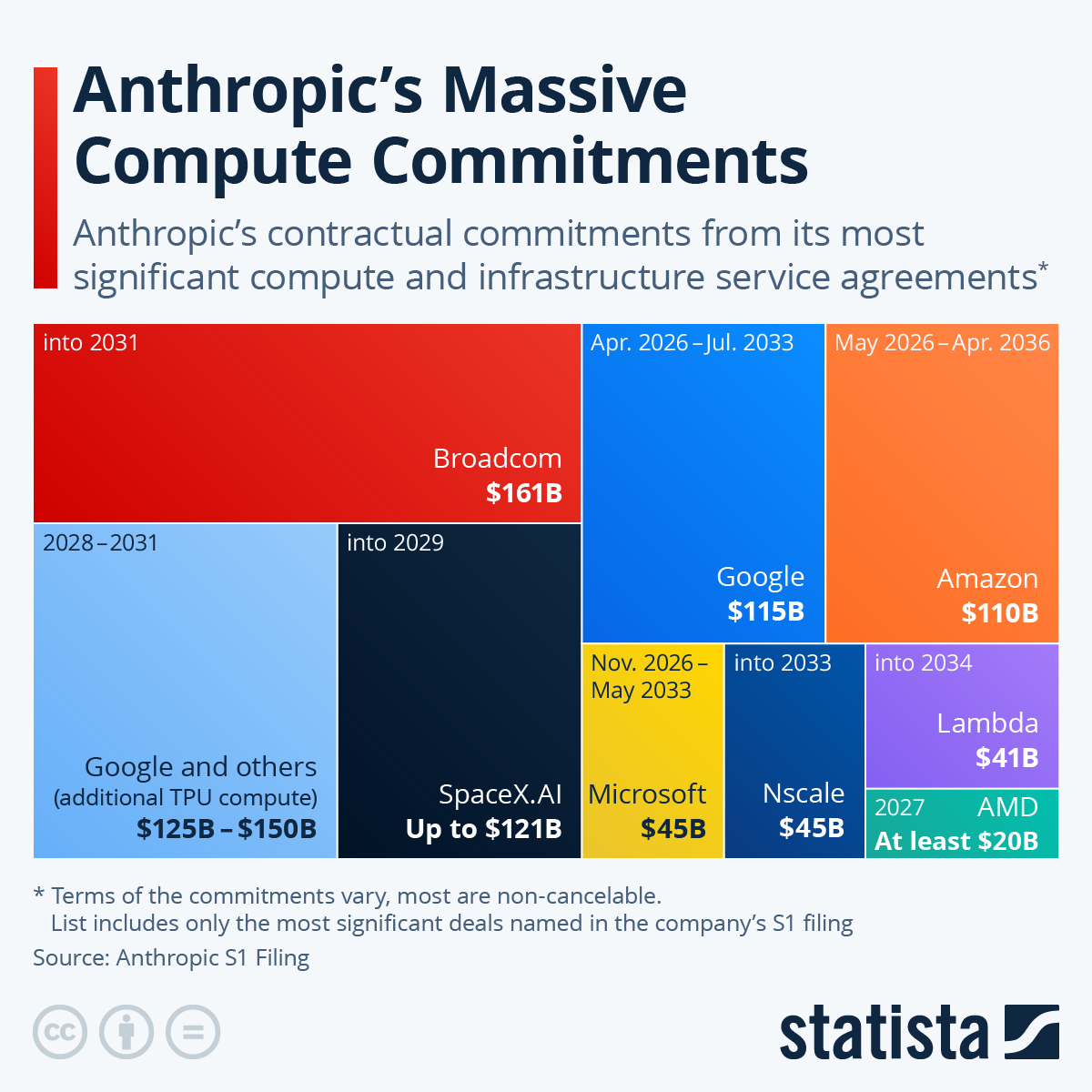
One of the most remarkable things about the AI boom is just how interconnected all the major players have become. Nvidia, Microsoft, Amazon, Google, OpenAI and Anthropic are investing in one another, buying each other's products and services, and helping finance the infrastructure that underpins the entire industry. It's an increasingly circular economy, with hundreds of billions of dollars flowing between a relatively small group of companies. And while that helps fuel extraordinary growth, it can also create enormous risks. The chart below gives some idea of just how much money is at stake - and this is just Anthropic.